Provides information on standards-based education, covering such topics as assessing students, tracking students' progress, and performance tasks and rubrics.
Provides information on standards-based education, covering such topics as assessing students, tracking students' progress, and performance tasks and rubrics.
Ensure All Students Master Content by Designing and Implementing a Pcbe System
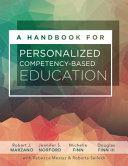
In K-12 education's growing movement of competency-based education and personalized learning, both contradictory and overlapping definitions come up around these two terms. To clear up this confusion, A Handbook for Personalized Competency-Based Education delves into the components of a personalized competency-based education (PCBE) system. This handbook explores approaches, strategies, and techniques that schools and districts should consider as they rethink traditional instruction to fit a PCBE system and support student learning. The authors share examples of how to use proficiency scales, standard operating procedures, behavior rubrics, personal tracking matrices, and other tools to aid in instruction and assessment. Benefits Receive clear guidance on implementing a personalized competency-based education (PCBE) system. Determine what content to focus on and what standards to prioritize in personalized instruction. Read vignettes that illustrate the shifts that should occur to foster PCBE. Learn how a flexible PCBE learning environment of student agency can foster self-efficacy. Understand the variety of assessments available for measuring student proficiency in a PCBE system. Contents Chapter 1: Why Competency-Based Education and Personalized Learning? Chapter 2: What Content Will Be Addressed? Chapter 3: How Will the Learning Environment Promote Student Agency? Chapter 4: How Will Instruction Support Student Learning? Chapter 5: How Will Student Proficiency Be Measured? Chapter 6: How Will Scheduling Accommodate Student Learning? Chapter 7: How Will Reporting Facilitate Student Learning? Chapter 8: How Do Schools and Districts Transition to a PCBE System? Epilogue Appendix A: Tools to Support Student Agency Appendix B: A Model of Effective Instruction Appendix C: Sample Grading Sheet Appendix D: Resources for Creating a Shared Vision
To clear up this confusion, A Handbook for Personalized Competency-Based Education delves into the components of a personalized competency-based education (PCBE) system.
They need to be able to apply their learning to authentic, reality-based situations.Engaging in Cognitively Complex Tasks: Classroom Strategies to Help Students Generate & Test Hypotheses Across Disciplines explores explicit techniques for ...
A critical step in helping all students achieve high standards! Robert Marzano brings Bloom's Taxonomy into the 21st century with a new model that incorporates the latest in cognitive science and research on how we learn. Students and educators reap the benefits of new ways to design instruction, curriculum and assessment. From student-led conferences to policy assessment implications, this definitive work brings assessment concepts up-to-date and offers practical solutions for today's classrooms. Highlights include: An overview of Bloom's Taxonomy A model for the new taxonomy The knowledge domains The three systems of thinking The next taxonomy and the three knowledge domains Applying the taxonomy to curriculum assessment design This landmark work provides an essential roadmap for educating today's students! Easily applied by teachers, administrators, and staff development personnel.
From student-led conferences to policy assessment implications, this definitive work brings assessment concepts up-to-date and offers practical solutions for today's classrooms.
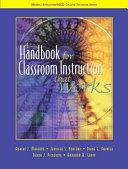
Designed as a self-study resource, this handbook guides readers through nine categories of instructional strategies proven to improve student achievement. Sections 1-9 address the nine categories of instructional strategies that can be applied to all types of content, at all grade levels, and with all types of students: Identifying similarities and differences; Summarizing and note taking; Reinforcing effort and providing recognition; Homework and practice; Representing knowledge; Learning groups; Setting objectives and providing feedback; Generating and testing hypotheses; and Cues, questions, and advance organizers. For each of the nine categories, exercises, brief questionnaires, tips and recommendations, samples, worksheets, rubrics, and other tools are provided. For elementary and middle school teachers, counselors, evaluators, and administrators.
Designed as a self-study resource, this handbook guides readers through nine categories of instructional strategies proven to improve student achievement.
This work offers an important and critical analysis of Moores conception of good and right. It aims to show how contemporary moral philosophy is still concerned with intrinsic value.
This work offers an important and critical analysis of Moores conception of good and right. It aims to show how contemporary moral philosophy is still concerned with intrinsic value.
As the 21st century unfolds, the pace of change in the world is accelerating. Teachers and administrators must lead the cultural shift required to ensure their students can survive and thrive in the changing world. In Teaching & Assessing 21st Century Skills the authors present a model of instruction and assessment based on a combination of cognitive skills (skills students will need to succeed academically) and conative skills (skills students will need to succeed interpersonally) necessary for the 21st century. The authors believe both cognitive and conative skills will be vital to the success of all citizens living and working in the highly varied and quickly changing knowledge economy of the 21st century. Part of The Classroom Strategies Series, this clear, highly practical guide follows the series format, first summarizing key research and then translating it into recommendations for classroom practice. In addition to the explanations and examples of strategies, each chapter includes helpful comprehension questions to reinforce the reader's understanding of the content to create both short- and long-term strategies for teaching and assessing 21st century skills.
Part of The Classroom Strategies Series, this clear, highly practical guide follows the series format, first summarizing key research and then translating it into recommendations for classroom practice.