This is a companion to Standards for Reading Professionals. It provides information for reading specialists, reading co-ordinators and teacher educators preparing for programme reviews. The guide helps to create a programme review folio that reflects their graduate reading programme.
This handbook, a companion to the revised vision of the "Standards for Reading Professionals" (1998), published by the International Reading Association (IRA), provides vital information to those preparing programs for any or all of the ...
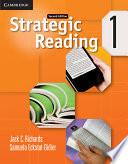
Strategic Reading is a three-level series designed to develop reading, vocabulary-building, and critical-thinking skills. Strategic Reading Level 1 is a reading skills book that contains twelve thematic units, each with three high interest readings. All readings come from authentic sources and have been slightly adapted to be appropriate for study by intermediate-level students. Exercise material surrounding the readings builds students' vocabulary and develops their reading and critical thinking skills.
Jack C. Richards, Samuela Eckstut-Didier. A gift card is a card that is issued by a
particular store. It's worth a certain amount of money. It looks like a credit card, but
it actually works like cash. A gift—card holder can spend the amount of money ...
The purpose of this study is to examine the effects of brain-based learning within the framework of two elementary schools that administer the Wisconsin Knowledge Concepts Exam. Teachers of these students were previously in-serviced on the implementation of brain-based learning strategies. This study's primary purpose is to gain an understanding of the effects of these practices on students as measured by the Reading Assessment from the Wisconsin Knowledge and Concepts Exam (WKCE). The method used was a survey designed by the researcher and distributed to the faculty of the students in grades three, four and five. The study found an increase in Reading scores as measured by the WKCE. The most significant change originated in students on the lower end of the continuum. This can be attributed to the current understanding that students scoring proficient or advanced had brains that were more efficient at the task of evaluating and analyzing text; therefore, the brains of these students did not require the extra enrichment provided by brain-based learning; however, for students at the lower end of the continuum, brain-based learning necessitated an increase in scores. There was positive correlation between brain-based learning strategies and expected student achievement for these students. The researcher recommends the research continue for two or more years to determine if the positive correlation continues.
The purpose of this study is to examine the effects of brain-based learning within the framework of two elementary schools that administer the Wisconsin Knowledge Concepts Exam.