Sebanyak 278 item atau buku ditemukan

Introduction to Mathematical Analysis

I have tried to provide an introduction, at an elementary level, to some of the important topics in real analysis, without avoiding reference to the central role which the completeness of the real numbers plays throughout. Many elementary textbooks are written on the assumption that an appeal to the complete ness axiom is beyond their scope; my aim here has been to give an account of the development from axiomatic beginnings, without gaps, while keeping the treatment reasonably simple. Little previous knowledge is assumed, though it is likely that any reader will have had some experience of calculus. I hope that the book will give the non-specialist, who may have considerable facility in techniques, an appreciation of the foundations and rigorous framework of the mathematics that he uses in its applications; while, for the intending mathe matician, it will be more of a beginner's book in preparation for more advanced study of analysis. I should finally like to record my thanks to Professor Ledermann for the suggestions and comments that he made after reading the first draft of the text.

I hope that the book will give the non-specialist, who may have considerable facility in techniques, an appreciation of the foundations and rigorous framework of the mathematics that he uses in its applications; while, for the intending ...


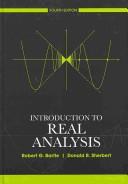
An Introduction to Real Analysis

This book is a set of notes for an elementary course in real analysis. It covers sequences, limits, continuity, differentiation, integration, and series.

This book is a set of notes for an elementary course in real analysis. It covers sequences, limits, continuity, differentiation, integration, and series.

A Concise Introduction to Analysis

This book provides an introduction to the basic ideas and tools used in mathematical analysis. It is a hybrid cross between an advanced calculus and a more advanced analysis text and covers topics in both real and complex variables. Considerable space is given to developing Riemann integration theory in higher dimensions, including a rigorous treatment of Fubini's theorem, polar coordinates and the divergence theorem. These are used in the final chapter to derive Cauchy's formula, which is then applied to prove some of the basic properties of analytic functions. Among the unusual features of this book is the treatment of analytic function theory as an application of ideas and results in real analysis. For instance, Cauchy's integral formula for analytic functions is derived as an application of the divergence theorem. The last section of each chapter is devoted to exercises that should be viewed as an integral part of the text. A Concise Introduction to Analysis should appeal to upper level undergraduate mathematics students, graduate students in fields where mathematics is used, as well as to those wishing to supplement their mathematical education on their own. Wherever possible, an attempt has been made to give interesting examples that demonstrate how the ideas are used and why it is important to have a rigorous grasp of them.

This book provides an introduction to the basic ideas and tools used in mathematical analysis.

An Introduction to Proof Through Real Analysis

An engaging and accessible introduction to mathematical proof incorporating ideas from real analysis A mathematical proof is an inferential argument for a mathematical statement. Since the time of the ancient Greek mathematicians, the proof has been a cornerstone of the science of mathematics. The goal of this book is to help students learn to follow and understand the function and structure of mathematical proof and to produce proofs of their own. An Introduction to Proof through Real Analysis is based on course material developed and refined over thirty years by Professor Daniel J. Madden and was designed to function as a complete text for both first proofs and first analysis courses. Written in an engaging and accessible narrative style, this book systematically covers the basic techniques of proof writing, beginning with real numbers and progressing to logic, set theory, topology, and continuity. The book proceeds from natural numbers to rational numbers in a familiar way, and justifies the need for a rigorous definition of real numbers. The mathematical climax of the story it tells is the Intermediate Value Theorem, which justifies the notion that the real numbers are sufficient for solving all geometric problems. • Concentrates solely on designing proofs by placing instruction on proof writing on top of discussions of specific mathematical subjects • Departs from traditional guides to proofs by incorporating elements of both real analysis and algebraic representation • Written in an engaging narrative style to tell the story of proof and its meaning, function, and construction • Uses a particular mathematical idea as the focus of each type of proof presented • Developed from material that has been class-tested and fine-tuned over thirty years in university introductory courses An Introduction to Proof through Real Analysis is the ideal introductory text to proofs for second and third-year undergraduate mathematics students, especially those who have completed a calculus sequence, students learning real analysis for the first time, and those learning proofs for the first time. Daniel J. Madden, PhD, is an Associate Professor of Mathematics at The University of Arizona, Tucson, Arizona, USA. He has taught a junior level course introducing students to the idea of a rigorous proof based on real analysis almost every semester since 1990. Dr. Madden is the winner of the 2015 Southwest Section of the Mathematical Association of America Distinguished Teacher Award. Jason A. Aubrey, PhD, is Assistant Professor of Mathematics and Director, Mathematics Center of the University of Arizona.

The goal of this book is to help students learn to follow and understand the function and structure of mathematical proof and to produce proofs of their own.

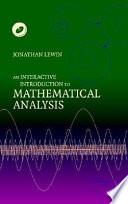
An Interactive Introduction to Mathematical Analysis Hardback with CD-ROM

This book provides a rigorous course in the calculus of functions of a real variable. Its gentle approach, particularly in its early chapters, makes it especially suitable for students who are not headed for graduate school but, for those who are, this book also provides the opportunity to engage in a penetrating study of real analysis.The companion onscreen version of this text contains hundreds of links to alternative approaches, more complete explanations and solutions to exercises; links that make it more friendly than any printed book could be. In addition, there are links to a wealth of optional material that an instructor can select for a more advanced course, and that students can use as a reference long after their first course has ended. The on-screen version also provides exercises that can be worked interactively with the help of the computer algebra systems that are bundled with Scientific Notebook.

This book provides a rigorous course in the calculus of functions of a real variable.

Yet Another Introduction to Analysis

Mathematics education in schools has seen a revolution in recent years. Students everywhere expect the subject to be well-motivated, relevant and practical. When such students reach higher education, the traditional development of analysis, often divorced from the calculus they learned at school, seems highly inappropriate. Shouldn't every step in a first course in analysis arise naturally from the student's experience of functions and calculus in school? And shouldn't such a course take every opportunity to endorse and extend the student's basic knowledge of functions? In Yet Another Introduction to Analysis, the author steers a simple and well-motivated path through the central ideas of real analysis. Each concept is introduced only after its need has become clear and after it has already been used informally. Wherever appropriate, new ideas are related to common topics in math curricula and are used to extend the reader's understanding of those topics. In this book the readers are led carefully through every step in such a way that they will soon be predicting the next step for themselves. In this way students will not only understand analysis, but also enjoy it.

In this book the readers are led carefully through every step in such a way that they will soon be predicting the next step for themselves. In this way students will not only understand analysis, but also enjoy it.