
Sebanyak 406 item atau buku ditemukan

Introduction to Analysis, An,

This is the eBook of the printed book and may not include any media, website access codes, or print supplements that may come packaged with the bound book. For one- or two-semester junior or senior level courses in Advanced Calculus, Analysis I, or Real Analysis. This text prepares students for future courses that use analytic ideas, such as real and complex analysis, partial and ordinary differential equations, numerical analysis, fluid mechanics, and differential geometry. This book is designed to challenge advanced students while encouraging and helping weaker students. Offering readability, practicality and flexibility, Wade presents fundamental theorems and ideas from a practical viewpoint, showing students the motivation behind the mathematics and enabling them to construct their own proofs.

This is the eBook of the printed book and may not include any media, website access codes, or print supplements that may come packaged with the bound book.
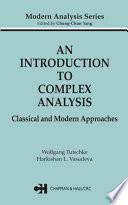
An Introduction to Complex Analysis

Classical and Modern Approaches

Like real analysis, complex analysis has generated methods indispensable to mathematics and its applications. Exploring the interactions between these two branches, this book uses the results of real analysis to lay the foundations of complex analysis and presents a unified structure of mathematical analysis as a whole. To set the groundwork and mitigate the difficulties newcomers often experience, An Introduction to Complex Analysis begins with a complete review of concepts and methods from real analysis, such as metric spaces and the Green-Gauss Integral Formula. The approach leads to brief, clear proofs of basic statements - a distinct advantage for those mainly interested in applications. Alternate approaches, such as Fichera's proof of the Goursat Theorem and Estermann's proof of the Cauchy's Integral Theorem, are also presented for comparison. Discussions include holomorphic functions, the Weierstrass Convergence Theorem, analytic continuation, isolated singularities, homotopy, Residue theory, conformal mappings, special functions and boundary value problems. More than 200 examples and 150 exercises illustrate the subject matter and make this book an ideal text for university courses on complex analysis, while the comprehensive compilation of theories and succinct proofs make this an excellent volume for reference.

More than 200 examples and 150 exercises illustrate the subject matter and make this book an ideal text for university courses on complex analysis, while the comprehensive compilation of theories and succinct proofs make this an excellent ...

An Introduction to Analysis

Part of the Jones and Bartlett International Series in Advanced Mathematics Completely revised and update, the second edition of An Introduction to Analysis presents a concise and sharply focused introdution to the basic concepts of analysis from the development of the real numbers through uniform convergences of a sequence of functions, and includes supplementary material on the calculus of functions of several variables and differential equations. This student-friendly text maintains a cautious and deliberate pace, and examples and figures are used extensively to assist the reader in understanding the concepts and then applying them. Students will become actively engaged in learning process with a broad and comprehensive collection of problems found at the end of each section.

This student-friendly text maintains a cautious and deliberate pace, and examples and figures are used extensively to assist the reader in understanding the concepts and then applying them.

Introduction to Mathematical Analysis

Our goal in this set of lecture notes is to provide students with a strong foundation in mathematical analysis. Such a foundation is crucial for future study of deeper topics of analysis. Students should be familiar with most of the concepts presented here after completing the calculus sequence. However, these concepts will be reinforced through rigorous proofs. The lecture notes contain topics of real analysis usually covered in a 10-week course: the completeness axiom, sequences and convergence, continuity, and differentiation. The lecture notes also contain many well-selected exercises of various levels. Although these topics are written in a more abstract way compared with those available in some textbooks, teachers can choose to simplify them depending on the background of the students. For instance, rather than introducing the topology of the real line to students, related topological concepts can be replaced by more familiar concepts such as open and closed intervals. Some other topics such as lower and upper semicontinuity, differentiation of convex functions, and generalized differentiation of non-differentiable convex functions can be used as optional mathematical projects. In this way, the lecture notes are suitable for teaching students of different backgrounds.

Our goal in this set of lecture notes is to provide students with a strong foundation in mathematical analysis.

Introduction to Calculus and Classical Analysis

This text is intended for an honors calculus course or for an introduction to analysis. Involving rigorous analysis, computational dexterity, and a breadth of applications, it is ideal for undergraduate majors. This third edition includes corrections as well as some additional material. Some features of the text include: The text is completely self-contained and starts with the real number axioms; The integral is defined as the area under the graph, while the area is defined for every subset of the plane; There is a heavy emphasis on computational problems, from the high-school quadratic formula to the formula for the derivative of the zeta function at zero; There are applications from many parts of analysis, e.g., convexity, the Cantor set, continued fractions, the AGM, the theta and zeta functions, transcendental numbers, the Bessel and gamma functions, and many more; Traditionally transcendentally presented material, such as infinite products, the Bernoulli series, and the zeta functional equation, is developed over the reals; and There are 385 problems with all the solutions at the back of the text.

This text is intended for an honors calculus course or for an introduction to analysis.

Introduction to Real Analysis

My purpose in writing this short book has been to present in a well- motivated
and natural sequence the basic ideas of classical real analysis. My intention has
been to offer a book that can be covered from beginning to end in one semester.

Introduction to Mathematical Analysis

I have tried to provide an introduction, at an elementary level, to some of the important topics in real analysis, without avoiding reference to the central role which the completeness of the real numbers plays throughout. Many elementary textbooks are written on the assumption that an appeal to the complete ness axiom is beyond their scope; my aim here has been to give an account of the development from axiomatic beginnings, without gaps, while keeping the treatment reasonably simple. Little previous knowledge is assumed, though it is likely that any reader will have had some experience of calculus. I hope that the book will give the non-specialist, who may have considerable facility in techniques, an appreciation of the foundations and rigorous framework of the mathematics that he uses in its applications; while, for the intending mathe matician, it will be more of a beginner's book in preparation for more advanced study of analysis. I should finally like to record my thanks to Professor Ledermann for the suggestions and comments that he made after reading the first draft of the text.

I hope that the book will give the non-specialist, who may have considerable facility in techniques, an appreciation of the foundations and rigorous framework of the mathematics that he uses in its applications; while, for the intending ...

An Introduction to Real Analysis

This book is a set of notes for an elementary course in real analysis. It covers sequences, limits, continuity, differentiation, integration, and series.

This book is a set of notes for an elementary course in real analysis. It covers sequences, limits, continuity, differentiation, integration, and series.