Sebanyak 739 item atau buku ditemukan

The New York Genealogical and Biographical Record

She married 27 October 183538 NATHAN MACCORKLE, who was born 7
January 1812 at or near Newtown, Bucks County, ... 3| john D. Mac Corkle death
certificate (1925, #105168), Division of Vital Records, Philadelphia: “born 3 May
1839, ...

The Descendants of William Witter and Hannah Churchman of Lynn, Massachusetts

Family history for the descendants of William Witter (1584-1659) and Hannah Churchman. Witter emigrated from England and settled in Lynn, MA. Descendants subsequently located throughout New England. Major family names include: Anderson, Button, Dean, Elmer, Palmer, and Williams. Genealogical data are current through 1989.

559. NATHAN PIERCE WITTER (Nathan , Nathan , Nathan , Ebenezer ,
Ebenezer3, Josiah2 , Williaml) b. Brooklyn, CT July l8, l8l9 d. Brooklyn, CT
September 20, l892. He married at Brooklyn, CT on March 8, l846 to HARRIET
HAWKINS b.

Harold F. Silver

Western Inventor, Businessman, and Civic Leader

Inventors such as Harold Farnes Silver can be counted among the few souls who reshape their time and place. Silver belongs in the company of such figures as Cyrus McCormick and fellow Utah natives John Moses Browning and Philo Farnsworth, for he created machines that transformed whole industries. An entrepreneur as well, he built corporations on the foundation of his inventions. He then shared his success and business acumen through civic service that strengthened the communities with which he was affiliated, especially Denver, Colorado, where he made his home. During World War II, as owner of a still fledgling business, he piloted the effort that brought inland shipyards hundreds of miles from the ocean to the city by the Rocky Mountains. As a philanthropist and as an organizer or participant in countless causes and business organizations, he left a rare legacy of public service through private means in Denver and elsewhere. Mastery of mechanical invention made Harold Silver's business and civic achievements possible. He was born into a family of mechanical engineers, craftsmen in iron and steel. Their trade was with mines, smelters, farms, and food factories, businesses whose products were the mainstays of the western economy. Sugar, from sugar beets, and coal were among the most important of those products. In the twentieth century new technology continued to alter farms and mines, but as midcentury approached, coal mines and sugar factories still employed many antiquated labor-intensive methods. Mechanization, chemistry, and automation had only begun to redefine the nature of work and production in these industries. Harold Silver had an unequaled role in creating the machinery that accelerated that process. He invented new means of receiving and processing sugar beets and extracting sugar from them, dramatically reducing labor needs and increasing production capabilities. Having revolutionized the sugar beet business, he then created a new way of obtaining sugar from its other major source, sugar cane. His influence on coal mining was perhaps even more important, earning him a place among America's greatest inventors. Silver's continuous coal miner, a teethed monster of a machine, tore out coal by the wall, moved it from the mining face, and loaded it for transport to the surface. It replaced back-breaking hand labor by miners, integrated the various tasks of several less-efficient machines, and made coal mining safer, less expensive, and more productive. Harold Silver faced a fair share of controversy and hardship along his road to achievement and success. From his youth in Salt Lake City as part of a polygamous and broken Mormon family to his own permanent break with his youngest son, episodes of personal tragedy as well as joy and public accomplishment shaped a life that has received insufficient notice.

Nathan Rosenberg, Technology and American Economic Growth (Armonk, N.Y.:
M. E. Sharpe, 1972). Joseph Rossman ... Yale University Press, 1970). Gregory C
. Thompson and Allan D. Ainsworth, EIMCO: The History 242 Harold F. Silver.


A Clinician's Guide to Maintaining and Enhancing Close Relationships

In the past 10 years, there has been a substantial increase in the number of theoretical and empirical investigations into the maintenance and enhancement of close, romantic relationships. This literature targets the everyday behaviors, expressions of love, and cognitive styles that characterize such relationships. Chapters provide a sampling of the expanse of topics in the domain of how clinical scholars and practitioners address the timely topic of maintaining and enhancing close romantic relationships, including marriage. A distinguished group of scholars and therapists discuss specific problems, such as alcoholism and therapeutic interventions, such as insight therapy. Topics include maintenance issues relevant to: depression, anxiety disorders, the role of children in affecting close relationships, how premarital therapy may serve as an antidote to early relationship problems, forgiveness, remarriage issues, and peer marriage. This volume is intended for practitioners in the field of close romantic relationships, such as marriage, family and relationship therapists, and clinicians.

Throughsuch thingsas personalized idiomatic communication, likeprivate
nicknames for people or relational acts(Bell, BuerkelRothfuss, & Gore,1987;
Bombar & Littig, 1996;Bruess & Pearson, 1993;Hopper, Knapp,&Scott, 1981),
romantic ...

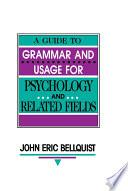
A Guide To Grammar and Usage for Psychology and Related Fields

Why another book on this topic? The author's experience editing leading journals in psychology suggests that publication manuals and books on writing about experimentation in psychology do not adequately address grammatical usage and style. Much of the advice published for scientific writers reads as if it had been written either by English teachers for writers who do not publish in scientific fields, or by scientific writers who think that the information already available in countless handbooks on grammar and style for student writers in English classes is enough. Unfortunately, such traditional handbooks do not offer the particular sorts of commentary that scientific writers need. This book offers specific advice on a host of issues ranging from the appropriate use of abbreviations to wordiness -- and how to avoid it. Dr. Bellquist's expertise in both the English language and the language of scientific writing ideally positions him to offer guidelines on the use of the passive, the best wording for statistical presentations, and just how to describe experimental procedures, among many other topics. Complete with examples and principles to guide writing decisions, this book will assist both students and seasoned professionals in presenting their work clearly for maximum impact. This book is intended as a guide to grammar and usage for writers in scientific fields -- particularly in experimental psychology and all fields related to experimental psychology. Features of the book include: * alphabetical entries and numerous cross references on grammar, usage, and style; * numerous examples taken from scientific papers or based on actual cases; * discussions of semantic problems of grammar such as modification, predication, and statement; * and discussions of usage specific to experimental psychology, statistics, and related fields.

It isoften awkward, however, to use where forabstract relationships thatare only
metaphorically spatial, unless thelanguage sanctions such instances as idioms.
Nomatterhow conventional itmay seem to some writers, to others it willseem ...

A Student Guide to Energy

This multivolume resource is an excellent research tool for developing a working knowledge of basic energy concepts and topics. * Includes interviews of teachers, students, and businesspeople in the renewable energy fields * Provides energy timelines charting the historic development of different energy sources * Offers 150 detailed Illustrations of electric vehicles and hydrogen fuel cells plus 50 tables, and charts of data * Presents a number of maps showing the global development of wind power, solar power, and geothermal power * A bibliography of print and online resources is included for further reading

John F. Mongillo. A STUDENT GUIDE Tl] ENERGY Vuluma 5: Energy Efficiency,
Eunsarvatiun, and Sustainability JnhnF Mnngilln ¢.€z:*:smea?.? A Student Guide
to Energy A STUDENT GUIDE TO ENERGY. Volume 5.

Montross

a family history; Pierre Montras and his descendants, a record of 300 years of the Montras, Montross, Montrose, Montress family in the United States and Canada

... in Cedar Rapids, where he lived at 3009 E Ave. N.E. ; 2 ch., both b. Cedar
Rapids : (a) Michael Sidney Augustine b. ... 8 Oct. 1936 Dale George Matheny,
corn sheller, b. 15 Mar. 1916, son of Glenn and Olive Matheny ; address : Centre
Point ...