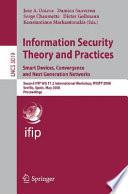
Second IFIP WG 11.2 International Workshop, WISTP 2008, Seville, Spain, May 13-16, 2008
This volume constitutes the refereed proceedings of the Second IFIP WG 11.2 International Workshop on Information Security Theory and Practices: Smart Devices, Convergence and Next Generation Networks, WISTP 2008, held in Seville, Spain, in May 2008. The 10 revised full papers presented were carefully reviewed and selected from numerous submissions for inclusion in the book; they examine the rapid development of information technologies and the transition to next generation networks. The papers focus on the security of these complex and resource-constrained systems and are organized in topical sections on smart devices, network security, convergence, and cryptography.
... dedicated storage, and dedicated security processors. 1 Introduction As
security takes on ever increasing importance in today's connected, digital world;
security solutions incorporate new, dedicated hardware at an increasing rate [1,2,
3,4 ...
This handbook contains surveys of state-of-the-art concepts, systems, applications, best practices as well as contemporary research in the intersection between IT and finance. Included are recent trends and challenges, IT systems and architectures in finance, essential developments and case studies on management information systems, and service oriented architecture modeling. The book shows a broad range of applications, e.g. in banking, insurance, trading and in non-financial companies. Essentially, all aspects of IT in finance are covered.
Conceptual. Ambiguities. in. Technology. Risk. Management. Christian Cuske,
Tilo Dickopp, Axel Korthaus, Stefan Seedorf ... The mentioned internal and
external factors are driving forces for operational technology risk management.
Naturally ...
Providing readers with a solid basis in dynamical systems theory, as well as explicit procedures for application of general mathematical results to particular problems, the focus here is on efficient numerical implementations of the developed techniques. The book is designed for advanced undergraduates or graduates in applied mathematics, as well as for Ph.D. students and researchers in physics, biology, engineering, and economics who use dynamical systems as model tools in their studies. A moderate mathematical background is assumed, and, whenever possible, only elementary mathematical tools are used. This new edition preserves the structure of the first while updating the context to incorporate recent theoretical developments, in particular new and improved numerical methods for bifurcation analysis.
1.1 Definition of a dynamical system The notion of a dynamical system is the mathematical formalization of the general scientific concept of a deterministic
process. The future and past states of many physical, chemical, biological,
ecological, ...
"This second edition contains new and additional exercises, and it includes a new chapter on the applications of PDEs to biology: age structured models, pattern formation, epidemic wave fronts, and advection-diffusion processes. The student who reads through this book and solves many of the exercises will have a sound knowledge base for upper division mathematics, science, and engineering courses where detailed models and applications are introduced."--BOOK JACKET.
"This second edition contains new and additional exercises, and it includes a new chapter on the applications of PDEs to biology: age structured models, pattern formation, epidemic wave fronts, and advection-diffusion processes.
4th International Conference, PPAM 2001 Naleczow, Poland, September 9-12, 2001 Revised Papers
This book constitutes the thoroughly refereed post-proceedings of the 4th International Conference on Parallel Processing and Applied Mathematics, PPAM 2002, held in Naleczow, Poland, in September 2001. The 101 papers presented were carefully reviewed and improved during two rounds of reviewing and revision. The book offers topical sections on distributed and grid architectures, scheduling and load balancing, performance analysis and prediction, parallel non-numerical algorithms, parallel programming, tools and environments, parallel numerical algorithms, applications, and evolutionary computing and neural networks.
Many problems in engineering, chemistry and physics require the representation
of solutions in complex geometries. In the paper we ... The control volume
method on the one hand, is based upon the simple physical principle of a flux
balance.
The subject of the book is the "know-how" of applied mathematical modelling: how to construct specific models and adjust them to a new engineering environment or more precise realistic assumptions; how to analyze models for the purpose of investigating real life phenomena; and how the models can extend our knowledge about a specific engineering process. Two major sources of the book are the stock of classic models and the authors' wide experience in the field. The book provides a theoretical background to guide the development of practical models and their investigation. It considers general modelling techniques, explains basic underlying physical laws and shows how to transform them into a set of mathematical equations. The emphasis is placed on common features of the modelling process in various applications as well as on complications and generalizations of models. The book covers a variety of applications: mechanical, acoustical, physical and electrical, water transportation and contamination processes; bioengineering and population control; production systems and technical equipment renovation. Mathematical tools include partial and ordinary differential equations, difference and integral equations, the calculus of variations, optimal control, bifurcation methods, and related subjects.
Mathematical models and methods provide a rigorous, systematic, and
quantitative description of various real-world (physical, chemical, biological)
phenomena. They help to understand and analyse the essential qualitative
features of these ...
This book provides a timely and unique survey of next-generation social computational methodologies. The text explains the fundamentals of this field, and describes state-of-the-art methods for inferring social status, relationships, preferences, intentions, personalities, needs, and lifestyles from human information in unconstrained visual data. Topics and features: includes perspectives from an international and interdisciplinary selection of pre-eminent authorities; presents balanced coverage of both detailed theoretical analysis and real-world applications; examines social relationships in human-centered media for the development of socially-aware video, location-based, and multimedia applications; reviews techniques for recognizing the social roles played by people in an event, and for classifying human-object interaction activities; discusses the prediction and recognition of human attributes via social media analytics, including social relationships, facial age and beauty, and occupation.
Despite the progress made during the last decade in video understanding,
extracting high-level semantics in the form of relations among the actors in a
video is still an under-explored area. This chapter discusses a streamlined
methodology to ...
This timely text/reference presents the latest advances in various aspects of social media modeling and social media computing research. Gathering together superb research from a range of established international conferences and workshops, the editors coherently organize and present each of the topics in relation to the basic principles and practices of social media modeling and computing. Individual chapters can be also be used as self-contained references on the material covered. Topics and features: presents contributions from an international selection of preeminent experts in the field; discusses topics on social-media content analysis; examines social-media system design and analysis, and visual analytic tools for event analysis; investigates access control for privacy and security issues in social networks; describes emerging applications of social media, for music recommendation, automatic image annotation, and the analysis and improvement of photo-books.
objects and relations in the music social community Last.fm. The relations include
friendship relations, membership relations, listening relations, tagging relations,
inclusion relations among resources (e.g., tracks and albums) and similarity ...
This concise primer (based on lectures given at summer schools on complex systems and on a masters degree course in complex systems modeling) will provide graduate students and newcomers to the field with the basic knowledge of the concepts and methods of statistical physics and its potential for application to interdisciplinary topics. Indeed, in recent years, statistical physics has begun to attract the interest of a broad community of researchers in the field of complex system sciences, ranging from biology to the social sciences, economics and computer science. More generally, a growing number of graduate students and researchers feel the need to learn some basic concepts and questions originating in other disciplines without necessarily having to master all of the corresponding technicalities and jargon. Generally speaking, the goals of statistical physics may be summarized as follows: on the one hand to study systems composed of a large number of interacting ‘entities’, and on the other to predict the macroscopic (or collective) behavior of the system considered from the microscopic laws ruling the dynamics of the individual ‘entities’. These two goals are, to some extent, also shared by what is nowadays called ‘complex systems science’ and for these reasons, systems studied in the framework of statistical physics may be considered as among the simplest examples of complex systems—allowing in addition a rather well developed mathematical treatment.
It is a pleasure to thank Guillaume Beslon, Tommaso Roscilde and Sébastian
Grauwin, who were also involved in some of the lectures mentioned above, as
well as Pablo Jensen for his efforts in setting up an interdisciplinary Master
course on ...
This book on constrained optimization is novel in that it fuses these themes: • use examples to introduce general ideas; • engage the student in spreadsheet computation; • survey the uses of constrained optimization;. • investigate game theory and nonlinear optimization, • link the subject to economic reasoning, and • present the requisite mathematics. Blending these themes makes constrained optimization more accessible and more valuable. It stimulates the student’s interest, quickens the learning process, reveals connections to several academic and professional fields, and deepens the student’s grasp of the relevant mathematics. The book is designed for use in courses that focus on the applications of constrained optimization, in courses that emphasize the theory, and in courses that link the subject to economics.
A variety of path-length problems will be posted in this chapter. They will be
solved by linear programming and, where appropriate, by other methods. The
phrases “linear programming” and “dynamic programming” are similar, but they
have ...