
Sebanyak 2866 item atau buku ditemukan

Developing Research Writing

A Handbook for Supervisors and Advisors

Developing Research Writing is designed to encourage, inspire and improve the advisory practice of providing writing feedback. This book provides insights and advice that supervisors can use to advance their support of their research students’ writing and, at the same time, survive increasing supervisory demands. Book parts are framed by empirical supervisor and doctoral student experiences and chapters within each part provide multiple approaches. The carefully chosen contributors are specialists on research writing and doctoral pedagogy, who guide the reader through the key stages of providing feedback. Split into nine key parts the book covers: starting a new supervision with writing in focus; making use of other resources along the way; encouraging style through control of language; writing feedback on English as an Additional Language (EAL) writing; Master’s and Honours smaller projects’ writing feedback; thesis by publication or performance-based writing; maintaining and gathering momentum; keeping the examiner happy; writing feedback as nudging through identity transition. The parts cohere into a go-to handbook for developing the supervision process. Drawing on research, literature and experience, Developing Research Writing offers well-theorized, yet practical and grounded advice conducive to good practices.

This book provides insights and advice that supervisors can use to advance their support of their research students’ writing and, at the same time, survive increasing supervisory demands.
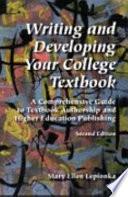
Writing and Developing Your College Textbook

A Comprehensive Guide to Textbook Authorship and Higher Education Publishing

This is the comprehensively revised second edition of a popular professional book on textbook writing and finding one's way in the higher education publishing world--for academic authors and editors, college instructors, and instructional designers. The second edition has two new chapters on the latest industry trends--such as the pricing revolt, open access movement, and wiki-textbook phenomenon, and on the use of learning objectives to structure textbook package development. Every chapter features new sections, links, forms, models, or examples from an even greater range of college courses. Contains updated and expanded appendices, glossary entries, references, bibliography entries, and index. BISAC: Language Arts & Disciplines/Authorship and Publishing

Verjetnostni račun in statistika

Slučajne mere subordinatorskega tipa : [slučajno vzorčenje iz Poissonovih procesov]. Del 1

Points of a Poisson point process in an abstract space are being sampled randomly. A point is chosen with probability proportional to its size where the size is defined as an arbitrary strictly positive function. The sizes of points chosen form a sequence of random variables whose distribution is described.These results are used to explain vhy in cases of "gamma" or "stable" one-sided Lévy processes the relative sizes of jumps can be represented by the random allocation model. A further application is to sampling of excursions of a Markov process away form a recurrent point, in particular for Brownian motion or Bessel processes for which the inverse local time is a stable one-sided Lévy proces. One of the theorems proved generalises the arcsine law for the time Brownian motion spends positive.

Points of a Poisson point process in an abstract space are being sampled randomly.

Introduction to Partial Differential Equations

From Fourier Series to Boundary-Value Problems

The self-contained treatment covers Fourier series, orthogonal systems, Fourier and Laplace transforms, Bessel functions, and partial differential equations of the first and second orders. 266 exercises with solutions. 1970 edition.

The self-contained treatment covers Fourier series, orthogonal systems, Fourier and Laplace transforms, Bessel functions, and partial differential equations of the first and second orders. 266 exercises with solutions. 1970 edition.

Testing in Language Programs

A Comprehensive Guide to English Language Assessment, New Edition

Testing in Language Programs is a textbook for graduate and undergraduate teacher training courses in language testing and assessment. Ideal for both classroom and personal reference, this book targets the needs of those making both program-level decisions (admissions, proficiency, and placement) as well as classroom-level decisions (e.g., assessing what students have learned through diagnostic and achievement testing.

Ideal for both classroom and personal reference, this book targets the needs of those making both program-level decisions (admissions, proficiency, and placement) as well as classroom-level decisions (e.g., assessing what students have ...

Testing the Chains

Resistance to Slavery in the British West Indies

Even those destined to live in the islands were usually educated in England like
English gentry — some very grandly indeed. After Eton or Harrow, Oxford or
Cambridge, the Inns of Court and the European Grand Tour, they would rarely
settle ...

How to Write a Suicide Note

Serial Essays That Saved a Woman's Life

How to Write a Suicide Note examines the life of a Chinese/Black woman who grew up passing for white, who grew up poor, who loves women but has always married white men. Writing has saved her life. It has allowed her to name the historical trauma--the racist, sexist, classist experiences that have kept her from being fully alive, that have screamed at her loudly and consistently that she was no good, and would never be any good-and that no one could love her. Writing has given her the creative power to name the experiences that dictated who she was, even before she was born, and write notes to them, suicide notes. Sherry Quan Lee believes writing saves lives; writing has saved her life. Acclaim for "How to Write a Suicide Note" "How to Write a Suicide Note is a haunting portrait of the daughter of an African mother and a Chinese father. Sherry dares to be who she isn't supposed to be, feel what she isn't supposed to feel, and destroys racial and gender myths as she integrates her bi-racial identity into all that she is. Through her raw honesty and vulnerability, Sherry captures a range of emotions most people are afraid to confront, or even share. Her work is a gift to the mental health community." --Beth Kyong Lo, M.A., Psychotherapist "Sherry Quan Lee offers us, in How to Write a Suicide Note, a deep breathing meditation on how love is under continuous revision. And like all the best Blues singers, Quan Lee voices the lowdown, dirty paces that living puts us through, but without regret or surrender." Wesley Brown, author of Darktown Strutters and Tragic Magic "I love the female aspects, the sex, and the strong voice Sherry Quan Lee uses to share her private life in How To Write A Suicide Note. I love the wit, the tongue-in-cheek, the trippiness of it all. I love the metaphors, especially the lover and suicide ones. I love the free-associations, the 'raving, ravenous, relentless' back and forth. Quan Lee breaks the rules and finds her genius. How to Write a Suicide Note is a passionate, risk-taking, outrageous, life-affirming book and love letter." Sharon Doubiago, author of Body and Soul, Hard Country; and other works Learn more about the author at www.SherryQuanLee.com Book #2 in the Reflections of History Series from Modern History Press www.ModernHistoryPress.com Modern History Press is an imprint of Loving Healing Press

Thanks to Sharon Doubiago, my Split Rock Arts Program Online Mentoring for
Writers mentor, for her generosity of time and exper‐tise. Thanks to Shay
Youngblood for reading How to Write a Suicide Note and insisting that I find a
publisher.

How to Write a Successful Research Grant Application

A Guide for Social and Behavioral Scientists

Over the last fifty years behavioral and medical research has been generously supported by the federal government, private foundations, and other philanthropic organizations contributing to the development of a vibrant public health system both in the United States and worldwide. However, these funds are dwindling and to stay competitive, investigators must understand the funding environment and know how to translate their hypotheses into research grant applications that reviewers evaluate as having scientific merit. The Second Edition of ‘How to Write a Successful Research Grant Application’ is the only book of its kind written by federal research investigators which provides technical assistance for researchers applying for biobehavioral and psychosocial research funding and can give them an edge in this competitive environment. The book provides invaluable tips on all aspects of the art of grantsmanship, including: how to determine research opportunities and priorities, how to develop the different elements of an application, how to negotiate the electronic submission and review processes, and how to disseminate the findings. Charts, visual aids, Web links, an extensive real-world example of a research proposal with budget, and a "So You Were Awarded Your Grant—Now What?" chapter show prospective applicants how to: - Formulate a testworthy—and interesting—hypothesis. - Select the appropriate research mechanism. - Avoid common pitfalls in proposal writing. - Develop an adequate control group. - Conduct a rigorous qualitative inquiry. - Develop a budget justification of costs. - Develop a human subjects of animal welfare plan. - Write a data analytic plan. - Design a quality control/assurance program. - Read between the lines of a summary of the review of your application. Although its focus is on Public Health Service funding, ‘How to Write a Successful Research Grant’ is equally useful for all research proposals, including graduate students preparing a thesis or dissertation proposal. Service providers in community-based organizations and public health agencies will also find this a useful resource in preparing a proposal to compete for grant funds from state and community resources, non-government organizations, and foundations.

(eds.), How to Write a Successful Research Grant Application: A Guidefor Social
and Behavioral Scientists, DOI 10.1007/978-1-4419-1454-5_4, © Springer
Science+Business Media, LLC 2011 to support research training for
underrepresented ...