
Sebanyak 1695 item atau buku ditemukan

Developing Science Writing Skills, Grades 5 - 8

Connect students in grades 5 and up with science using Developing Science Writing Skills. This 80-page book helps students speak and write effectively when they present scientific information. Students focus on writing clear and concise hypotheses, design experiments, and write explanations, descriptions, and summaries. In the final chapter, students write a science report, which pulls together all of the writing elements from previous chapters. The book supports National Science Education Standards.

The National Council of Teachers Standards for English and Language Arts
stress that it is important for students to develop writing and speaking skills to
communicate effectively with a variety of audiences and for different purposes.
Effective ...
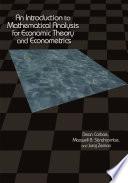
An Introduction to Mathematical Analysis for Economic Theory and Econometrics

Providing an introduction to mathematical analysis as it applies to economic theory and econometrics, this book bridges the gap that has separated the teaching of basic mathematics for economics and the increasingly advanced mathematics demanded in economics research today. Dean Corbae, Maxwell B. Stinchcombe, and Juraj Zeman equip students with the knowledge of real and functional analysis and measure theory they need to read and do research in economic and econometric theory. Unlike other mathematics textbooks for economics, An Introduction to Mathematical Analysis for Economic Theory and Econometrics takes a unified approach to understanding basic and advanced spaces through the application of the Metric Completion Theorem. This is the concept by which, for example, the real numbers complete the rational numbers and measure spaces complete fields of measurable sets. Another of the book's unique features is its concentration on the mathematical foundations of econometrics. To illustrate difficult concepts, the authors use simple examples drawn from economic theory and econometrics. Accessible and rigorous, the book is self-contained, providing proofs of theorems and assuming only an undergraduate background in calculus and linear algebra. Begins with mathematical analysis and economic examples accessible to advanced undergraduates in order to build intuition for more complex analysis used by graduate students and researchers Takes a unified approach to understanding basic and advanced spaces of numbers through application of the Metric Completion Theorem Focuses on examples from econometrics to explain topics in measure theory

Providing an introduction to mathematical analysis as it applies to economic theory and econometrics, this book bridges the gap that has separated the teaching of basic mathematics for economics and the increasingly advanced mathematics ...

A Modern Introduction to Differential Equations

A Modern Introduction to Differential Equations, Second Edition, provides an introduction to the basic concepts of differential equations. The book begins by introducing the basic concepts of differential equations, focusing on the analytical, graphical, and numerical aspects of first-order equations, including slope fields and phase lines. The discussions then cover methods of solving second-order homogeneous and nonhomogeneous linear equations with constant coefficients; systems of linear differential equations; the Laplace transform and its applications to the solution of differential equations and systems of differential equations; and systems of nonlinear equations. Each chapter concludes with a summary of the important concepts in the chapter. Figures and tables are provided within sections to help students visualize or summarize concepts. The book also includes examples and exercises drawn from biology, chemistry, and economics, as well as from traditional pure mathematics, physics, and engineering. This book is designed for undergraduate students majoring in mathematics, the natural sciences, and engineering. However, students in economics, business, and the social sciences with the necessary background will also find the text useful. Student friendly readability- assessible to the average student Early introduction of qualitative and numerical methods Large number of exercises taken from biology, chemistry, economics, physics and engineering Exercises are labeled depending on difficulty/sophistication End of chapter summaries Group projects

This book is designed for undergraduate students majoring in mathematics, the natural sciences, and engineering. However, students in economics, business, and the social sciences with the necessary background will also find the text useful.

Student Solutions Manual, A Modern Introduction to Differential Equations

Student Solutions Manual, A Modern Introduction to Differential Equations

Student Solutions Manual, A Modern Introduction to Differential Equations

Introduction to Differential Equations

This book provides students with solid knowledge of the basic principles of differential equations and a clear understanding of the various ways of obtaining their solutions by applying suitable methods. It is primarily intended to serve as a textbook for undergraduate students of mathematics. It will also be useful for undergraduate engineering students of all disciplines as part of their course in engineering mathematics. No book on differential equations is complete without a treatment of special functions and special equations. A chapter in this book has been devoted to the detailed study of special functions such as the gamma function, beta function, hypergeometric function, and Bessel function, as well as special equations such as the Legendre equation, Chebyshev equation, Hermite equation, and Laguerre equation. The general properties of various orthogonal polynomials such as Legendre, Chebyshev, Hermite, and Laguerre have also been covered. A large number of solved examples as well as exercises at the end of many chapter sections help to comprehend as well as to strengthen the grasp of the underlying concepts and principles of the subject. The answers to all the exercises are provided at the end of the book.

This book provides students with solid knowledge of the basic principles of differential equations and a clear understanding of the various ways of obtaining their solutions by applying suitable methods.

Testing and Assessment in Translation and Interpreting Studies

A call for dialogue between research and practice

Testing and Assessment in Translation and Interpreting Studies examines issues of measurement that are essential to translation and interpreting. Conceptualizing testing both as a process and a product, the collection of papers explores these issues across languages and settings (including university classrooms, research projects, the private sector, and professional associations). The authors have approached their chapters from different perspectives using a variety of methods, some focusing on very specific variables, and others providing a much broader overview of the issues at hand. Chapters range from a discussion of the measurement of text cohesion in translation; the measurement of interactional competence in interpreting; the use of a particular scale to measure interpreters’ renditions to the application of a specific approach to grading or general program assessment (such as interpreter or translator certification at the national level or program admissions processes). These studies point to the need for greater integration of research and practice in the specific area of testing and assessment and are a welcome addition to the field.

Assessing ASL-English interpreters The Canadian model of national certification
Debra Russell and Karen Malcolm University of Alberta / Douglas College This
chapter highlights the certification processes for signed language interpreters in ...

Testing the Chains

Resistance to Slavery in the British West Indies

Even those destined to live in the islands were usually educated in England like
English gentry — some very grandly indeed. After Eton or Harrow, Oxford or
Cambridge, the Inns of Court and the European Grand Tour, they would rarely
settle ...

How to Write a Selling Screenplay

Christopher Keane has spent 20 years in the business, learning the truths--and the tricks--of writing a selling screenplay. In How to Write a Selling Screenplay, he takes writers through the entire process, from developing a story to finding the best agent. Using an annotated version of an often-optioned screenplay of his own, and citing examples from movies ranging from Casablanca and Lethal Weapon to Sling Blade and The English Patient, he discusses how to create three-dimensional characters, find a compelling story, build an airtight plot structure, fine-tune dialogue, and much more. Keane's tips on the difference between writing for film and television, as well as his advice on dealing with Hollywood movers and shakers, make this an essential companion for people writing their first--or their fortieth--screenplay. From the Trade Paperback edition.

4 Writing for Television I'm a Hollywood writer; I put on my sports jacket and take
off my brain. Ben Hecht, screenwriter of Spellbound, Notorious, Cunga Din,
Scadace, and The Front Page The question my entertainment attorney asks
when I ...