Sebanyak 55 item atau buku ditemukan

Perempuan dibawa/h laki-laki yang kalah

Kekerasan terhadap perempuan Timor Timur dalam kamp pengungsian di Timor Barat

Civil and military violence against women refugees during disintegration of Timor Timur Province from Indonesia.

Runtuhnya sistem dan aturan sosial hidup bersama ini berlaku pula pada sistem
perlindungan tradisional. Sistem perlindungan masyarakat yang seharusnya
berada dalam suatu komunitas tidak berlaku di kamp. Dalam budaya Timor, jika
ada seorang perempuan yang menjadi hamil oleh seorang laki-laki di luar
pernikahan, maka keluarga perempuan akan menuntut laki-laki itu untuk
menikah dengan perempuan tersebut, dan menuntut laki-laki beserta
keluarganya untuk ...

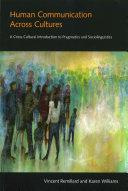
Human Communication Across Cultures

A Cross-Cultural Introduction to Pragmatics and Sociolinguistics

Human Communication across Cultures is a highly interactive textbook and workbook on how human communication takes place. Unlike other textbooks which focus only on sociolinguistics this book employs both sociolinguistics and pragmatics. Sociolinguistics explores how language is used in social interactions. There are differences in the way we speak due to where we live, gender, age, race/ethnicity, religious background and our social class and level of education. Pragmatics shows how we speak differently and understand one another in each situation we encounter. Each section of the book includes a brief introduction, a discussion of the topic, references for further research and an extensive collection of activities designed for both in-class usage and homework assignments. The book features numerous examples from a variety of current world cultures.

[The book] is a highly interactive textbook and workbook on how human commnication takes place. Unlike other textbooks which focus only on sociolinguistics, this book employs both sociolinguistics and pragmatics.

Theories of Human Communication

Complements and expands students' understanding and use of the book. Includes chapter summaries, vocabulary lists with page references, activities, research logs, group assignment worksheets and self-tests.

Complements and expands students' understanding and use of the book. Includes chapter summaries, vocabulary lists with page references, activities, research logs, group assignment worksheets and self-tests.

Ethics in Human Communication

Sixth Edition

Broad in scope, yet precise in exposition, the Sixth Edition of this highly acclaimed ethics text has been infused with new insights and updated material. Richard Johannesen and new coauthors Kathleen Valde and Karen Whedbee provide a thorough, comprehensive overview of philosophical perspectives and communication contexts, pinpointing and explicating ethical issues unique to human communication. Chief among the authors objectives are to: provide classic and contemporary perspectives for making ethical judgments about human communication; sensitize communication participants to essential ethical issues in the human communication process; illuminate complexities and challenges involved in making evaluations of communication ethics; and offer ideas for becoming more discerning evaluators of others communication. Provocative questions and illustrative case studies stimulate reflexive thinking and aid readers in developing their own approach to communication ethics. A comprehensive list of resources spotlights books, scholarly articles, videos, and Web sites useful for further research or personal exploration.

Communication. “North Americans . . . too often assume that people elsewhere
hold comparable values, or would, at least if they were given the opportunity.”
Thus John Condon underscores the fact that standards for ethical communication
rooted in a North American value system, such as the political perspectives
discussed in chapter 2, are not widely shared throughout the world. Criteria of
linear logic, empirical observation, and objective truth are not used to assess
communication ...

Theories of Human Communication

Eleventh Edition

The Eleventh Edition is organized around: (1) elements of the basic communication model—communicator, message, medium, and “beyond” human communication; and (2) communication contexts—relationship, group, organization, health, culture, and society. A new chapter discusses four frameworks by which theories can be organized; students can see how theories contribute to and are impacted by larger issues about the nature of inquiry. To provide comprehensive, up-to-date coverage of theories, the authors surveyed articles in communication journals published over the last five years. Each chapter covers an average of 13 theories, half of which are new to this edition. New areas covered include health, social media, and “beyond human communication”—communication between humans and nature, humans and objects, humans and technology, humans and the divine. “From the Source” boxes give students a look at the theorists behind the theories—their inspirations, motivations, and goals. Written in an accessible style, the book is ideal for upper-division undergraduate classes and as a comprehensive summary of major theories for the graduate level.

To provide comprehensive, up-to-date coverage of theories, the authors surveyed articles in communication journals published over the last five years. Each chapter covers an average of 13 theories, half of which are new to this edition.

HBR Guide to Office Politics

Every organization has its share of political drama: Personalities clash. Agendas compete. Turf wars erupt. But you need to work productively with your colleagues—even the challenging ones—for the good of your organization and your career. How can you do that without compromising your integrity? By acknowledging that power dynamics and unwritten rules exist—and constructively navigating them. Whether you're a new professional or an experienced one, this guide will teach you how to: (1) Build relationships with difficult people, (2) gain allies and increase your sphere of influence, (3) wrangle resources, (4) move up without alienating your colleagues, (5) avoid power games and petty rivalries, and (6) claim credit when it's due.

Whether you're a new professional or an experienced one, this guide will teach you how to: (1) Build relationships with difficult people, (2) gain allies and increase your sphere of influence, (3) wrangle resources, (4) move up without ...