Sebanyak 405 item atau buku ditemukan

Developing Writing

Specials! are a teaching resource designed for KS3 students, whose literacy skills are considerably lower than their age. These books have an 'older format' to counteract the simple text, and cover various topics. They include activities, visuals, and assessment sheets, as well as teacher pages.

Specials! are a teaching resource designed for KS3 students, whose literacy skills are considerably lower than their age. These books have an 'older format' to counteract the simple text, and cover various topics.

Developing Writing Skills in Arabic

Developing Writing Skills in Arabic is specifically designed for upper-intermediate to advanced students who need to write Arabic for personal, professional and academic purposes. Making use of reading comprehension, analysis of stylistic devices, a functional approach to grammar and well-graded exercises, the book exposes the student to a wide variety of styles and registers. Each chapter starts with a passive approach by letting the students analyze and discuss a sample text in the genre. It then moves on to a productive approach by expanding vocabulary, practicing using stylistic devices, studying grammar points pertinent to the main linguistic function of the chapter, and concludes with writing short and long compositions, both guided and free. The following writing styles and genres are covered: Personal writing – greetings, congratulating, condolences, social and family contact Professional writing – advertising, applying to a school, writing a résumé Giving instructions – notes, directions, recipes, technical instructions Description and comparison – objects and places, people and characters Narration – events and stories, autobiographies, biographies and diaries Academic writing – stating an idea, explaining a hypothesis, providing examples, facts and data. Written by an experienced teacher of Arabic and trialled with non-native students of Arabic, Developing Writing Skills in Arabic is the ideal resource to help students write clearly, coherently and appropriately in a variety of contexts.

Making use of reading comprehension, analysis of stylistic devices, a functional approach to grammar and well-graded exercises, the book exposes the student to a wide variety of styles and registers.

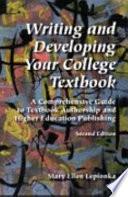
Writing and Developing Your College Textbook

A Comprehensive Guide to Textbook Authorship and Higher Education Publishing

This is the comprehensively revised second edition of a popular professional book on textbook writing and finding one's way in the higher education publishing world--for academic authors and editors, college instructors, and instructional designers. The second edition has two new chapters on the latest industry trends--such as the pricing revolt, open access movement, and wiki-textbook phenomenon, and on the use of learning objectives to structure textbook package development. Every chapter features new sections, links, forms, models, or examples from an even greater range of college courses. Contains updated and expanded appendices, glossary entries, references, bibliography entries, and index. BISAC: Language Arts & Disciplines/Authorship and Publishing

Developing Writing Skills

Helping to develop essential writing skills progressively, this resource builds on students' knowledge to fully equip them for the Year 7 and 8 English tests. It covers the framework objectives linked to the optional tests, using the KS3 strategy's recommended approach to teaching and learning.

Helping to develop essential writing skills progressively, this resource builds on students' knowledge to fully equip them for the Year 7 and 8 English tests.

Writing and Developing Your College Textbook Supplements

She then writes pedagogy for each piece (questions, activities, or writing or
research assignments for students) and puts it all together for production.
Production may consist of photocopying and stapling double-sided pages for
each of her ...

Reading, Writing, Mathematics and the Developing Brain: Listening to Many Voices

This valuable addition to the literature offers readers a comprehensive overview of recent brain imaging research focused on reading, writing and mathematics—a research arena characterized by rapid advances that follow on the heels of fresh developments and techniques in brain imaging itself. With contributions from many of the lead scientists in this field, a number of whom have been responsible for key breakthroughs, the coverage deals with the commonalities of, as well as the differences between, brain activity related to the three core educational topics. At the same time, the volume addresses vital new information on both brain and behavior indicators of developmental problems, and points out the new directions being pursued using current advances in brain imaging technologies as well as research-based interventions. The book is also a tribute to a new Edmund, J Safra Brain center for the study of learning Disabilities at the University of Haifa-Israel.

Victoria J. Molfese, Ph.D. and Zvia Breznitz, Ph.D. Reading and writing skills are
important for effective communication in a literate society. The human brain was
created about 60,000 years ago and the alphabetic code only about 5,000 years
 ...