Sigmund Freud evolved his theories throughout his lifetime. This entailed many revisions and changes which he himself never tried to standardize rigidly into a definitive conceptual system. The need for some sort of a reliable guide which would spell out both the pattern of the evolution of Freud's thinking, as well as establish its inherent logic, was felt for a long time by both scholars and students of psychoanalysis. Drs. Laplanche and Pontalis of the Association Psychoanalytique de France succeeded admirably in providing a dictionary of Freud's concepts which is more than a compilation of mere definitions. After many years of creative and industrious research, they were able to give an authentic account of the evolution of each concept with pertinent supporting texts from Freud's own writing (in the Standard Edition translation), and thus have endowed us with an instrument for work and research which is characterized by its thoroughness, exactitude and lack of prejudice towards dogma.The Language of Psychoanalysis has already established itself as a classic, and will long continue to be indispensible guide to psychoanalytic vocabulary for both student and research-worker in psychoanalysis.
The idea of a symbolic order which structures interhuman reality was introduced
into the social sciences above all by Claude Levi-Strauss (1), who took as his
model the structural linguistics developed from the teaching of Ferdinand de ...
In turning now to an investigation of the dynamics of speech we are but taking the
next logical step in the development of linguistic study. Previous studies of
language which have made this step inevitable have also furnished the student
of ...
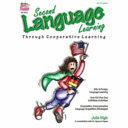
Cooperative learning was found to have large positive effects on motivation and strategy use, and medium-to-large positive effects on grammar achievement. Overall, the findings indicated a consistent pattern in favor of cooperative learning over whole-class instruction in teaching the Taiwanese learners English grammar. The results of the exploratory questions indicated that cooperative learning facilitated motivation and strategy use of learners across all subgroups, but more so with those performing at higher and lower levels. Grammar achievement of learners at higher and lower levels was affected positively. Additional analyses also indicated cooperative learning positively affected learning at higher cognitive levels. Implications for future research and for curriculum and instruction are addressed.
Additional analyses also indicated cooperative learning positively affected learning at higher cognitive levels. Implications for future research and for curriculum and instruction are addressed.
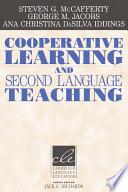
Although Cooperative Learning has steadily grown in popularity in second-language classrooms, few resources are available that cover the topic in depth. Cooperative Learning in Second Language Teaching is a comprehensive overview, suitable for MA TESOL programs and for in-service teachers. Part I provides a grounding for collaborative/cooperative learning by discussing the educational research, issues that surround its implementation, and how it relates to theories of second language learning. Part II is a series of six narrative chapters written by teachers from around the world. These teachers share their experiences using cooperative learning in their classrooms, demonstrating the effectiveness of this approach, in both second and foreign language contexts, for elementary, secondary and post-secondary levels of instruction. An appendix outlining the techniques in these chapters is also included.
In this original text, case histories demonstrate the effectiveness of the cooperative learning approach in both second and foreign language contexts for elementary through post-secondary levels.
Practical English Language Teaching offers a thorough yet practical overview of language teaching methodology for teachers and teachers in preparation. The principles outlined in each chapter are richly illustrated with vignettes and extracts from real classrooms so the reader can see what the principles "look like" when realized in classroom teaching. The book is divided into three sections: Exploring Skills, Exploring Language, and Supporting the Learning Process. FEATURES: Critical areas of language teaching are comprehensively addressed with a specific focus on practical techniques, strategies, and tips. World-class specialists like Neil Andersen, Kathleen M. Bailey, Mary Ann Christison, and David Nunan offer a variety of perspectives on language teaching and the learning process. Reflection questions invite readers to think about critical issues in language teaching while Action tasks outline strategies for putting new techniques into practice. Thoughtful suggestions for books, articles, and Web sites offer resources for additional, up-to-date information. Expansive glossary offers short and straightforward definitions of core language teaching terms. This package include the PELT Listening text with an accompanying audio CD.
Exploring Second Language Classroom Research is a comprehensive introductory manual for beginning and advanced researchers. Authored by two leading experts in the field, the text explores research traditions and processes. The text is illustrated with a variety of qualitative and quantitative data and includes tasks for reflection and application.
Authored by two leading experts in the field, the text explores research traditions and processes. The text is illustrated with a variety of qualitative and quantitative data and includes tasks for reflection and application.