Sebanyak 17 item atau buku ditemukan

Data Mining dan Machine Learning Menggunakan Matlab dan Phyton

Data Mining : Menemukan Pengetahuan dalam Data

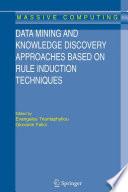
Data Mining and Knowledge Discovery Approaches Based on Rule Induction Techniques

This book outlines the core theory and practice of data mining and knowledge discovery (DM & KD) examining theoretical foundations for various methods, and presenting an array of examples, many drawn from real-life applications. Most theoretical developments are accompanied by extensive empirical analysis, offering a deep insight into both theoretical and practical aspects of the subject. The book presents the combined research experiences of 40 expert contributors of world renown.

METHODS. Andrew Kusiak Intelligent Systems Laboratory Mechanical and
Industrial Engineering 2139 Seamans Center The University of Iowa Iowa City,
Iowa 52242 - 1527 Email andrew-kusiak (du iowa . edu Web: http://www. iCaen.
uiowa. edu/~ank usiak Abstract: Key Words: A typical data mining project uses
data collected for various purposes, ranging from routinely gathered data, to
process improvement projects, and to data required for archival purposes. In
some cases, the ...

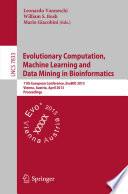
Evolutionary Computation, Machine Learning and Data Mining in Bioinformatics

11th European Conference, EvoBIO 2013, Vienna, Austria, April 3-5, 2013, Proceedings

This book constitutes the refereed proceedings of the 11th European Conference on Evolutionary Computation, Machine Learning and Data Mining in Bioinformatics, EvoBIO 2013, held in Vienna, Austria, in April 2013, colocated with the Evo* 2013 events EuroGP, EvoCOP, EvoMUSART and EvoApplications. The 10 revised full papers presented together with 9 poster papers were carefully reviewed and selected from numerous submissions. The papers cover a wide range of topics in the field of biological data analysis and computational biology. They address important problems in biology, from the molecular and genomic dimension to the individual and population level, often drawing inspiration from biological systems in oder to produce solutions to biological problems.

The task of predicting protein functions using computational techniques is a
major research area in the field of bioinformatics. Casting the task into a
classification problem makes it challenging, since the classes (functions) to be
predicted are ...

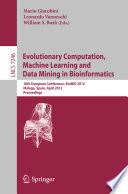
Evolutionary Computation, Machine Learning and Data Mining in Bioinformatics

10th European Conference, EvoBIO 2012, Málaga, Spain, April 11-13, 2012, Proceedings

This book constitutes the refereed proceedings of the 10th European Conference on Evolutionary Computation, Machine Learning and Data Mining in Bioinformatics, EvoBIO 2012, held in Málaga, Spain, in April 2012 co-located with the Evo* 2012 events. The 15 revised full papers presented together with 8 poster papers were carefully reviewed and selected from numerous submissions. Computational Biology is a wide and varied discipline, incorporating aspects of statistical analysis, data structure and algorithm design, machine learning, and mathematical modeling toward the processing and improved understanding of biological data. Experimentalists now routinely generate new information on such a massive scale that the techniques of computer science are needed to establish any meaningful result. As a consequence, biologists now face the challenges of algorithmic complexity and tractability, and combinatorial explosion when conducting even basic analyses.

Inferring Disease-Related Metabolite Dependencies with a Bayesian
Optimization Algorithm Holger Franken1, Alexander Seitz1, Rainer Lehmann2,3,
Hans-Ulrich Häring2,3, Norbert Stefan2,3, and Andreas Zell1 1 Center for
Bioinformatics ...

Evolutionary Computation, Machine Learning and Data Mining in Bioinformatics

8th European Conference, EvoBIO 2010, Istanbul, Turkey, April 7-9, 2010, Proceedings

The ?eld of bioinformatics has two main objectives: the creation and main- nance of biological databases, and the discovery of knowledge from life sciences datainordertounravelthemysteriesofbiologicalfunction,leadingtonewdrugs andtherapiesforhumandisease. Life sciencesdatacomeinthe formofbiological sequences, structures, pathways, or literature. One major aspect of discovering biological knowledge is to search, predict, or model speci?c information in a given dataset in order to generate new interesting knowledge. Computer science methods such as evolutionary computation, machine learning, and data mining all have a great deal to o?er the ?eld of bioinformatics. The goal of the 8th - ropean Conference on Evolutionary Computation, Machine Learning, and Data Mining in Bioinformatics (EvoBIO 2010) was to bring together experts in these ?elds in order to discuss new and novel methods for tackling complex biological problems. The 8th EvoBIO conference was held in Istanbul, Turkey during April 7–9, 2010attheIstanbulTechnicalUniversity. EvoBIO2010washeldjointlywiththe 13th European Conference on Genetic Programming (EuroGP 2010), the 10th European Conference on Evolutionary Computation in Combinatorial Opti- sation (EvoCOP 2010), and the conference on the applications of evolutionary computation,EvoApplications. Collectively,the conferences areorganizedunder the name Evo* (www. evostar. org). EvoBIO, held annually as a workshop since 2003, became a conference in 2007 and it is now the premiere European event for those interested in the interface between evolutionary computation, machine learning, data mining, bioinformatics, and computational biology.

8th European Conference, EvoBIO 2010, Istanbul, Turkey, April 7-9, 2010,
Proceedings Clara Pizzuti, Marylyn D. Ritchie, Mario Giacobini. Finding Gapped
Motifs by a Novel Evolutionary Algorithm Chengwei Lei and Jianhua Ruan
Department ...

Evolutionary Computation in Data Mining

Data mining (DM) consists of extracting interesting knowledge from re- world, large & complex data sets; and is the core step of a broader process, called the knowledge discovery from databases (KDD) process. In addition to the DM step, which actually extracts knowledge from data, the KDD process includes several preprocessing (or data preparation) and post-processing (or knowledge refinement) steps. The goal of data preprocessing methods is to transform the data to facilitate the application of a (or several) given DM algorithm(s), whereas the goal of knowledge refinement methods is to validate and refine discovered knowledge. Ideally, discovered knowledge should be not only accurate, but also comprehensible and interesting to the user. The total process is highly computation intensive. The idea of automatically discovering knowledge from databases is a very attractive and challenging task, both for academia and for industry. Hence, there has been a growing interest in data mining in several AI-related areas, including evolutionary algorithms (EAs). The main motivation for applying EAs to KDD tasks is that they are robust and adaptive search methods, which perform a global search in the space of candidate solutions (for instance, rules or another form of knowledge representation).

This carefully edited book reflects and advances the state of the art in the area of Data Mining and Knowledge Discovery with Evolutionary Algorithms.

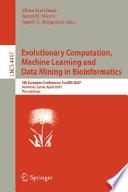
Evolutionary Computation, Machine Learning and Data Mining in Bioinformatics

5th European Conference, EvoBIO 2007, Valencia, Spain, April 11-13, 2007, Proceedings

The ?eld of bioinformatics has two main objectives: the creation and main- nance of biological databases, and the discovery of knowledge from life sciences data in order to unravel the mysteries of biological function, leading to new drugs and therapies for human disease. Life sciences data come in the form of biological sequences, structures, pathways, or literature. One major aspect of discovering biological knowledge is to search, predict, or model speci?c patterns present in a given dataset and then to interpret those patterns. Computer science methods such as evolutionary computation, machine learning, and data mining all have a great deal to o?er the ?eld of bioinformatics. The goal of the Fifth European Conference on Evolutionary Computation, Machine Learning, and Data Mining in Bioinformatics (EvoBIO 2007) was to bring experts in computer science - gether with experts in bioinformatics and the biological sciences to explore new and novel methods for solving complex biological problems. The ?fth EvoBIO conference was held in Valencia, Spain during April 11-13, 2007 at the Universidad Politecnica de Valencia. EvioBIO 2007 was held jointly with the Tenth European Conference on Genetic Programming (EuroGP 2007), the Seventh European Conference on Evolutionary Computation in Combina- rial Optimisation (EvoCOP 2007), and the Evo Workshops. Collectively, the c- ferences and workshops are organized under the name Evo* (www. evostar. org).

... clinical safety (black), efficacy (red), formulation (green), PK/bioavailability (
blue), commercial (yellow), toxicology (gray), cost of goods (purple) and others (
white). development of computational tools applicable for pharmacokinetic
profiling, ...

Konsep Data Mining Vs Sistem Pendukung Keputusan

Sistem Pendukung Keputusan (SPK) digunakan dalam pengambilan keputusan serta bagaimana pola-pola menyelesaikan masalah dengan beberapa metode pemecahan masalah. Atas dasar itu, buku ini akan menambah pengetahuan seluruh pembaca sehingga dapat menjadi pedoman di dalam penyelesaian suatu kasus berkenaan dengan SPK dan Data Mining. [Penerbit Deepublish, Deepublish, Dicky Nofriansyah, S.Kom., M.Kom.]

Sekilas Tentang Data Mining Data Mining adalah suatu istilah yang digunakan
untuk menguraikan penemuan pengetahuan di dalam database. Data Mining
adalah proses yang menggunakan teknik statistic, matematika, kecerdasan
buatan, ...

Dynamic and Advanced Data Mining for Progressing Technological Development: Innovations and Systemic Approaches

Innovations and Systemic Approaches

"This book discusses advances in modern data mining research in today's rapidly growing global and technological environment"--Provided by publisher.

Oard (Oard, 1997), describes a generic information filtering model as having four
components: a method for representing the documents within the domain; a
method for representing the user's information need; a method for making the ...