Sebanyak 2866 item atau buku ditemukan

Meeting the Challenge of Human Resource Management

A Communication Perspective

While communicating is a vital skill for managers at all organizational levels and in all functional areas, human resource managers are expected to be especially adept communicators, given the important interpersonal component of their roles. Practitioners and scholars alike stand to benefit from incorporating an updated and more nuanced view of communication theory and practice into standard human resource management practices. This book compiles readings by thought leaders in human resource management and communication, exploring the intersection of interests, theories, and perspectives from the two fields to highlight new opportunities for research and practice. In addition to covering the foundations of strategic human resource management, the book: offers a critical review of the research literature on topics including recruitment, selection, performance management, compensation, and development uses a communication perspective to analyze the impact of corporate strategy on human resource systems investigates the key human resource management topic of the relationship between a company's human capital and its effectiveness directly discusses the implications of communication literature for human resource management practice Written at the cross-section of two established and critcally linked fields, this book is a must-have for graduate human resource management and organizational communication students, as well as for high-level human resource management practitioners.

This book compiles readings by thought leaders in human resource management and communication, exploring the intersection of interests, theories, and perspectives from the two fields to highlight new opportunities for research and practice.

Human Communication

Motivation, Knowledge, and Skills

HUMAN COMMUNICATION: MOTIVATION, KNOWLEDGE AND SKILLS, Second Edition, features the collaborative work of recognized experts in the fields of communication and offers a unified approach to the basic processes of human communication backed by skill assessment. Beginning with the premise that all forms of communication have the potential to be viewed as competent depending on the context or situation, the text helps readers develop a framework for choosing among communication messages that will allow them to act competently. The theoretically based and skills-oriented framework emphasizes the basic themes of motivation, knowledge and skills across interpersonal communication, electronically mediated communication, small group communication, public speaking, and-new to the Second Edition-mass communication to help students become competent communicators in their own lives.

Communication. Sloane. had heard about how much fun chat rooms could be.
Given her interest in the television show The Apprentice, a chat room seemed a
natural wayof keeping up with the current buzz of the show. However, Sloane
had also heard that women tended to be in the minority in such chat rooms, and
as a result, got hit on by geeks and lonely guys who could not meet people any
other way. She decided to enter the chat room under an assumed male identity,
Ted, and ...

Human Communication as a Field of Study

Selected Contemporary Views

Authors analyze and discuss significant theories, research, and practices in various areas of this field. The final section considers future directions. Seventeen essays on the history of the field, communication theory in business and cultural contexts, and future directions. Paper edition (unseen), $18.95. Annotation copyrighted by Book News, Inc., Portland, OR

While communication research traditionally emphasized the study of language
and verbal messages, scholars today are increasingly interested in nonverbal
communication. Nonverbal codes appear to complement language, expanding
the efficiency and effectiveness of human communication. The study of nonverbal
communication extends our view of the human communicator. And it provides
new insights into the structure, function, and evolution of communication systems,
large ...

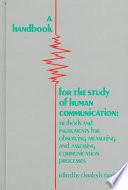
A Handbook for the Study of Human Communication

Methods and Instruments for Observing, Measuring, and Assessing Communication Processes

This book describes the available options, and the rationale for selecting among them, for observing, measureing or assessing process of communication. This approach contrasts radically to the one taken in many preceding volumes which explain the applicability of general types of quantitative research, for example, content analysis, laboratory experiments, and statistical analysis, to the study of communication. This approach focuses on the methodological problems and solutions unique to the study of communication. It provides the readers with an outline of the problems and/or alternatives that face the researcher.

This book describes the available options, and the rationale for selecting among them, for observing, measureing or assessing process of communication.

Theories of Human Communication

Eleventh Edition

The Eleventh Edition is organized around: (1) elements of the basic communication model—communicator, message, medium, and “beyond” human communication; and (2) communication contexts—relationship, group, organization, health, culture, and society. A new chapter discusses four frameworks by which theories can be organized; students can see how theories contribute to and are impacted by larger issues about the nature of inquiry. To provide comprehensive, up-to-date coverage of theories, the authors surveyed articles in communication journals published over the last five years. Each chapter covers an average of 13 theories, half of which are new to this edition. New areas covered include health, social media, and “beyond human communication”—communication between humans and nature, humans and objects, humans and technology, humans and the divine. “From the Source” boxes give students a look at the theorists behind the theories—their inspirations, motivations, and goals. Written in an accessible style, the book is ideal for upper-division undergraduate classes and as a comprehensive summary of major theories for the graduate level.

To provide comprehensive, up-to-date coverage of theories, the authors surveyed articles in communication journals published over the last five years. Each chapter covers an average of 13 theories, half of which are new to this edition.


The Construct Lesson Plan

Improving Group Instruction

A lesson plan is mainly teacher oriented. It is important, therefore, that the
prescription of instruction within the lesson plan be stringent in prescribing what
must occur; yet it must be flexible, so that interaction can take place. A canned
interactive instructional design, such as a film or audio recording, will be
presented the same way every time. Compare this to a teacher presentation via a
lesson plan wherein each lesson is not presented the same way every time. In
the teacher lesson ...