Sebanyak 708 item atau buku ditemukan

Information Technology and the Productivity Paradox

Assessing the Value of Investing in IT

From networks to databases, email to voicemail, the amount of capital being invested in information technology each year is staggering. By 1996, U.S. firms were spending more than $500 billion annually on software, networks and staff. The recently merged Bank of America and NationsBank have an initial IT budget of 4 billion dollars. As firms like this push rapidly into the business world of the 21st century, the question has remained: how do firms measure returns from these substantial investments in information technology? Henry C. Lucas, effectively answers this question by providing a creative and reliable framework for measuring the competitive advantages and profits gained through investments in state-of-the-art information systems. There is value in information technology, and it is possible to show returns, Lucas argues--unfortunately this value just doesn't always show up clearly on the bottom line of a ledger. In five expertly presented sections, he spells out exactly what businesses can expect from their information technology investments--some investments create a measurable value, some do not, but all are important nonetheless. Through a precise mix of frameworks and models, such as an Investment Opportunities Matrix, and punctuated with real examples from successful firms, this is the first book to allow executives to see exactly how their information technology investment can be expected to return value, thereby maximizing their advantages in an age of global competitiveness. Indeed, firms who manage their information systems most efficiently are best suited to succeed in a rapidly evolving marketplace. With so much at stake, Information Technology is certain to be the essential guide for firms determined to compete and flourish in the highly competitive economy of the next century.

What is the value of investments in information technology (IT)? Is there a return
from investing in IT? These two questions are critical because firms invest huge
amounts in information technology; an estimated 50 percent of U.S. capital ...

Information Technology

The Public Issues

This volume records the processings of the Fulbright Colloquium on Information Technology: The Public Issues which was held at the University of Sout hampton from Tuesday 16 September to Friday 29 September 1986. The Fulbright Commission in London felt that an Anglo-American conference on this subject was particularly appropriate at this time. Information technology (IT) has been at the forefront of informed debate on both sides of the Atlantic for a number of years and has been recognised as an issue of major importance in both countries, affecting all strands of society.

Three scenarios for the future of technology and democracy BENJAMIN R.
BARBER Princeton University Modernity may be defined politically by the
institutions of democracy, and socially and culturally by the civilisation of
technology.

Information Technology and the Corporation of the 1990s

Research Studies

One of the most pathbreaking and influential business books of the 1990s is The Corporation of the 1990s by Michael Scott Morton. Its expert view of how information technology would influence organizations and their ability to survive and prosper in the 1990s has become the benchmark of thinking about information technology. Now, in a supporting companion volume, Information Technology and the Corporation of the 1990s makes available the research on which The Corporation of the 1990s was based. The research was conducted at the Sloan School of Management at MIT by the Management in the 1990s program. The program was funded by a group of 12 industrial and government sponsors from the United States and Britain which included American Express, Digital Equipment Corporation, Eastman Kodak, British Petroleum, MCI Communications, General Motors, U.S. Army, ICL Ltd., Internal Revenue Service, Ernst & Young, BellSouth, and CIGNA Corporation. Information Technology and the Corporation of the 1990s aims to disseminate ideas on how organizations can manage the impact of information technology, and also to raise issues and stimulate further thought by both academics and professionals. The book is divided into three sections which cover the information technology revolution, strategic options, and organization and management responses. It incorporates the work of many important scholars including Charles Jonscher, Michael J. Piore, Thomas W. Malone. JoAnne Yates, Robert I. Benjamin, Gary W. Loveman, Eric von Hippel, Edgar H. Schein, Stanley M. Besen, Garth Saloner, N. Venkatraman, Akbar Zaheer, John C. Henderson, Jay C. Cooprider, Kevin Crowston, Jeongsuk Koh, Gordon Walker, Laura Poppo, John S. Carroll, Constance Perin, Brian T. Pentland, John Chalykoff, Lotte Bailyn, D. Eleanor Westney, Sumantra Ghoshal, John D.C. Little, Thomas J. Allen, Oscar Hauptman, Lisa M. Lynch, Paul Osterman, Thomas A. Kochan, and John Paul MacDuffie.

As does its companion volume, The Corporation of the 1990s, this book begins
with an overview of the information technology revolution. In the first chapter,
Charles Jonscher places these revolutionary changes into historical perspective
in an ...

Introduction to Information Retrieval

Class-tested and coherent, this textbook teaches classical and web information retrieval, including web search and the related areas of text classification and text clustering from basic concepts. It gives an up-to-date treatment of all aspects of the design and implementation of systems for gathering, indexing, and searching documents; methods for evaluating systems; and an introduction to the use of machine learning methods on text collections. All the important ideas are explained using examples and figures, making it perfect for introductory courses in information retrieval for advanced undergraduates and graduate students in computer science. Based on feedback from extensive classroom experience, the book has been carefully structured in order to make teaching more natural and effective. Slides and additional exercises (with solutions for lecturers) are also available through the book's supporting website to help course instructors prepare their lectures.

Christopher D. Manning, Prabhakar Raghavan, Hinrich Schütze. classification
search crawler Christopher D. Manning Prabhakar Raghavan Hinrich schütze
links introduction to — information Retrieval * query index web language model ...

Biometrika

One Hundred Years

The book celebrates the centenary of Biometrika, one of the world's leading academic journals in statistical theory and methodology by collating two sets of papers from the journal. One set consists of seven articles that review the journal's contribution to statistical science; the other set contains ten seminal papers from the journals first hundred years. The book opens with an introduction by the editors Professor D.M. Titterington and Sir David Cox.

The year 2001 marks the centenary of Biometrika, one of the world's leading academic journals in statistical theory and methodology. In celebration of this, the book brings together two sets of papers from the journal.

The New Cambridge Medieval History: Volume 6, C.1300-c.1415

The sixth volume of The New Cambridge Medieval History covers the fourteenth century, a period dominated by plague, other natural disasters and war which brought to an end three centuries of economic growth and cultural expansion in Christian Europe, but one which also saw important developments in government, religious and intellectual life, and new cultural and artistic patterns. Part I sets the scene by discussion of general themes in the theory and practice of government, religion, social and economic history, and culture. Part II deals with the individual histories of the states of western Europe; Part III with that of the Church at the time of the Avignon papacy and the Great Schism; and Part IV with eastern and northern Europe, Byzantium and the early Ottomans, giving particular attention to the social and economic relations with westerners and those of other civilisations in the Mediterranean.

The sixth volume of The New Cambridge Medieval History covers the fourteenth century, a period dominated by plague, other natural disasters and war which brought to an end three centuries of economic growth and cultural expansion in ...

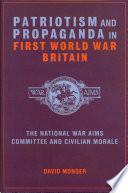
Patriotism and Propaganda in First World War Britain

The National War Aims Committee and Civilian Morale

This book is the first comprehensive investigation of the National War Aims Committee, providing detailed discussion of the establishment, activities and reception of the British domestic propaganda organisation, together with a careful and extensive analysis of the patriotic content of its propaganda.

1 Lasswell, Propaganda Technique, p. 47. 2 Morgan, National Identities, p. 217.
3 Colley, 'Britishness and Otherness', p. 311. See pp. 91-92 above. 4 Hall,
Civilising Subjects, p. 20. 5 Edward W Said, Adversaries at Home and Abroad:
The ...

Modernism, Media, and Propaganda

British Narrative from 1900 to 1945

Though often defined as having opposite aims, means, and effects, modernism and modern propaganda developed at the same time and influenced each other in surprising ways. The professional propagandist emerged as one kind of information specialist, the modernist writer as another. Britain was particularly important to this double history. By secretly hiring well-known writers and intellectuals to write for the government and by exploiting their control of new global information systems, the British in World War I invented a new template for the manipulation of information that remains with us to this day. Making a persuasive case for the importance of understanding modernism in the context of the history of modern propaganda, Modernism, Media, and Propaganda also helps explain the origins of today's highly propagandized world. Modernism, Media, and Propaganda integrates new archival research with fresh interpretations of British fiction and film to provide a comprehensive cultural history of the relationship between modernism and propaganda in Britain during the first half of the twentieth century. From works by Joseph Conrad to propaganda films by Alfred Hitchcock and Orson Welles, Mark Wollaeger traces the transition from literary to cinematic propaganda while offering compelling close readings of major fiction by Virginia Woolf, Ford Madox Ford, and James Joyce.

With respect to style and narrative technique, the three books are
indistinguishable. ... propagandize even as he wrote propaganda grounded in
impressionist technique, Ford betrays a deeper connection between modernism
and propaganda.

Mathematical Models in the Applied Sciences

Presents a thorough grounding in the techniques of mathematical modelling, and proceeds to explore a range of classical and continuum models from an array of disciplines.

Presents a thorough grounding in the techniques of mathematical modelling, and proceeds to explore a range of classical and continuum models from an array of disciplines.