Sebanyak 94 item atau buku ditemukan

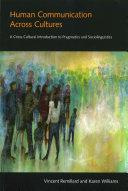
Human Communication Across Cultures

A Cross-Cultural Introduction to Pragmatics and Sociolinguistics

Human Communication across Cultures is a highly interactive textbook and workbook on how human communication takes place. Unlike other textbooks which focus only on sociolinguistics this book employs both sociolinguistics and pragmatics. Sociolinguistics explores how language is used in social interactions. There are differences in the way we speak due to where we live, gender, age, race/ethnicity, religious background and our social class and level of education. Pragmatics shows how we speak differently and understand one another in each situation we encounter. Each section of the book includes a brief introduction, a discussion of the topic, references for further research and an extensive collection of activities designed for both in-class usage and homework assignments. The book features numerous examples from a variety of current world cultures.

[The book] is a highly interactive textbook and workbook on how human commnication takes place. Unlike other textbooks which focus only on sociolinguistics, this book employs both sociolinguistics and pragmatics.


Sahifah Hammam ibn Munabbih

the earliest extant work on the Hadith : comprising as-Sahifah as-Sahihah of Abu-Hurairah (d. 58H./677) prepared for his pupil Hammam Ibn Munabbih (d. 101H./719), together with an introduction to the history of the early compilation of the Hadith

Isti'ab, No. 1947 (§ 'Amr ibn al- Ahtamm.) 2. Ibn Hajar, Tahdhib at.Tahdhib III 475
No. 883. 3. Ibn Sa'd, Tabaqat IV/i p. 150; Ibn Abd al-Barr Isti'ab, No. 1441 (§
Abdullah ibn Umm Maktum). 4. Ibn Hisham, Sirah, p. 436 and 506; Tabari Ta'rikh
I 1298 and 1304. 5. Ibn Sa'd, Tabaqat H/i p. 14; Suhaili Raud al-Unuf II 92; Ibn
Hanbal, Musnad No. 2216 (or I, 247) where the teacher vindictively beats his
pupil; Abu 'Ubaid, Amwal, § 309 (p. 115-6); etc. 6. Ibn Taimiyah, as-Siyasah a^h-
Shar'iyah, ...

Understanding and Using Statistics in Psychology

A Practical Introduction

`There are few people who can write about research methods in a lively and engaging way, but Miles and Banyard are amongst them. As well as being an exceptionally clear introduction to research methods, it is full of amusing asides and anecdotes that make you want to read more. A hugely enjoyable book' - Dr Andy Field, University of Sussex Understanding and Using Statistics in Psychology takes the fear out of psychological statistics to help students understand why statistics are carried out, how to choose the best test and how to carry out the tests and understand them. Taking a non-technical approach, it encourages the reader to understand why a particular test is being used and what the results mean in the context of a psychological study, focusing on meaning and understanding rather than mindless numerical calculation. Key features include: - A light and accessible style - Descriptions of the most commonly used statistical tests and the principles that underlie them - Real world examples to aid the understanding of why statistics are valuable - Boxes on common errors, tips and quotes - Test yourself questions The perfect introductory resource, Understanding and Using Statistics in Psychology will guide any student new to statistics effortlessly through the process of test selection and analysis. (Read Jeremy Miles's blog and access other useful information on statistics now at www.jeremymiles.co.uk)

Optional. Extra. Interestingly (well, we think it's interesting), Bonferroni didn't have
a greatdeal to do withBonferroni correction. The proofrequired for Bonferroni
correction relies on Boole's inequality (which Bonferroni extended, but this
extension wasn't needed for Bonferroni correction). It was actually first applied by
Dunn (1961) andhence issometimes known as Dunn'scorrection. Thisisa further
example of Stigler's lawof eponymy, which we described in Chapter2, page 20.

Ethics

A Contemporary Introduction

Harry Gensler’s Ethics introduces undergraduates to the main issues in contemporary moral philosophy. It also relates these issues to practical controversies, with special attention paid to racism, moral education, and abortion. It gives a practical method for thinking about moral issues, a method based largely on the golden rule. Key Features: • Serves as either the sole textbook for a lower-level introduction to ethics/moral philosophy course or a supplementary text for a more advanced undergraduate ethics course • Provides clear, direct writing throughout, making each chapter easily accessible for an engaged undergraduate • Offers a philosophically rigorous presentation of the golden rule • Includes helpful study aids, including: bolded technical terms, boxes for key ideas, chapter summaries, suggested readings, and a glossary/index Key additions to the Second Edition: • A new chapter on virtue ethics, which deals with Aristotle, Plato, and related controversies • A new chapter on natural law theory, which deals with Aquinas, double effect, sexual morality, and related controversies • A significantly revised chapter on the golden rule, which is now much clearer on certain key points • A significantly revised chapter on nonconsequentialism, which now has expanded coverage of human rights, libertarianism, and socialism, and uses the right to health care as a case example • An expanded bibliography • A new appendix that overviews key books students will want to pursue upon completing Ethics: A Contemporary Introduction, Second Edition • A rewritten instructional program, EthiCola, which is now much easier to download and use and has (for students) revised exercises for each chapter and (for instructors) a score-processing program, class slides, and instructor’s manual. This can be found on the book’s companion website: http://www.routledge.com/textbooks/gensler.

Key Features: • Serves as either the sole textbook for a lower-level introduction to ethics/moral philosophy course or a supplementary text for a more advanced undergraduate ethics course • Provides clear, direct writing throughout, ...

Object-Oriented Analysis and Design Using UML

An Introduction to Unified Process and Design Patterns

A modern computer program, such as the one that controls a rocket’s journey to moon, is like a medieval cathedral—vast, complex, layered with circuits and mazes. To write such a program, which probably runs into a hundred thousand lines or more, knowledge of an object-oriented language like Java or C++ is not enough. Unified Modelling Language (UML), elaborated in detail in this book, is a methodology that assists in the design of software systems. The first task in the making of a software product is to gather requirements from the client. This well-organized and clearly presented text develops a formal method to write down these requirements as Use Cases in UML. Besides, it also develops the concepts of static and dynamic modelling and the Unified Process that suggests incremental and iterative development of software, taking client feedback at every step. The concept of Design Patterns which provide solutions to problems that occur repeatedly during software development is discussed in detail in the concluding chapters. Two appendices provide solutions to two real-life problems. Case Studies, mapping of examples into Java code that are executable on computers, summary and Review Questions at the end of every chapter make the book reader friendly. The book will prove extremely useful to undergraduate and postgraduate students of Computer Science and Engineering, Information Technology, and Master of Computer Applications (MCA). It will also benefit professionals who wish to sharpen their programming skills using UML.

Unified Modelling Language (UML), elaborated in detail in this book, is a methodology that assists in the design of software systems. The first task in the making of a software product is to gather requirements from the client.

Applying UML and Patterns

An Introduction to Object-oriented Analysis and Design and Iterative Development

This guide for software engineers was written especially to provide the foundation for how to build systems using object technology. It provides students and developers with a detailed activity roadmap to guide them through each step of requirements, analysis, design, and coding. During the design phase, it places special emphasis on the critical skills needed for responsibility and collaboration design

This guide for software engineers was written especially to provide the foundation for how to build systems using object technology.

The Republic of Plato

Books I. V., With Introduction and Notes (Classic Reprint)

Excerpt from The Republic of Plato: Books I. V., With Introduction and Notes In the case of the Republic, a solitary edition by a Bachelor of Arts of Trinity College, Cambridge, Edmund Massey, in 1713, interrupts this long neglect. Unfortunately its date is its only interest. It is a pity that a far more competent and famous Cantabrigian did not undertake the task in which Massey failed. The poet Gray, equally at home in art and philosophy, perhaps the most learned man in Europe of his time, and the nicest critic, a little later than Massey, compiled for his own use a body of notes on Plato, which, in their matter, and still more their method, show what he might have done as a professed scholar, and cause us to regret that we have not an edition of the Republic by the author of the Elegy. As it was, no new commentary on the Republic appeared in Europe until the early years of our own century, when Ast published his three successive editions, modifying and advancing himself in the last, by aid of the critical labours of Bekker. About the Publisher Forgotten Books publishes hundreds of thousands of rare and classic books. Find more at www.forgottenbooks.com This book is a reproduction of an important historical work. Forgotten Books uses state-of-the-art technology to digitally reconstruct the work, preserving the original format whilst repairing imperfections present in the aged copy. In rare cases, an imperfection in the original, such as a blemish or missing page, may be replicated in our edition. We do, however, repair the vast majority of imperfections successfully; any imperfections that remain are intentionally left to preserve the state of such historical works.

About the Publisher Forgotten Books publishes hundreds of thousands of rare and classic books. Find more at www.forgottenbooks.com This book is a reproduction of an important historical work.

Understanding English Grammar

A Linguistic Introduction

Unlike other textbooks, it helps students to understand grammar rather than see it as a set of facts and rules.

Preface. The grammar of a language is a dynamic, constantly changing set of
habit patterns that allows people to ... “Why are there two 'future tenses'?,” “Why
do my students have such a hard time using English motion verbs?,” and so on.