Sebanyak 13 item atau buku ditemukan

Student's Solutions Guide for Discrete Mathematics and Its Applications

Answers to ODD numbered problems are in the back of the book. WORKED OUT SOLUTIONS for these ODD numbered problems are in the PRINTED Student's Solutions Guide (0-07-7353501). Complete SOLUTIONS for the EVEN NUMBERED PROBLEMS are available for the Instructor ONLY in the Instructor's Resource Guide link under the Instructor Resources.
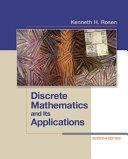
Answers to ODD numbered problems are in the back of the book.

Loose Leaf Version for Discrete Mathematics and Its Application

Discrete Mathematics and its Applications, Seventh Edition, is intended for one- or two-term introductory discrete mathematics courses taken by students from a wide variety of majors, including computer science, mathematics, and engineering. This renowned best-selling text, which has been used at over 500 institutions around the world, gives a focused introduction to the primary themes in a discrete mathematics course and demonstrates the relevance and practicality of discrete mathematics to a wide a wide variety of real-world applications...from computer science to data networking, to psychology, to chemistry, to engineering, to linguistics, to biology, to business, and to many other important fields.

Discrete Mathematics and its Applications, Seventh Edition, is intended for one- or two-term introductory discrete mathematics courses taken by students from a wide variety of majors, including computer science, mathematics, and engineering ...

Pluralism: The Future of Religion

Theology of religions has defaulted in the last two decades to an epicyclic inclusivism which seeks to undermine pluralism with claims that it is covertly triumphalistic and that it mirrors the logic of exclusivism. With the exception of pioneers in the field such as John Hick and Paul Knitter, most major figures in this theological field have retreated from pluralism and promote versions of particularism and inclusivism. Pluralism: The Future of Religion argues for an apophatic pluralism that is motivated by the insight that it is impossible to secure universal assent for changeable bodies of religious teachings. This insight implies the non-finality and consequent 'departicularization' of all religious teachings and their inclusivistic defenses. These conclusions point us inevitably toward pluralism and lead us out of the inclusivistic impasse of contemporary theology in religions.

See Kevin T. Bauder, “Fundamentalism,” in The Spectrum of Evangelicalism,
edited by Andrew David Naselli and Collin Hansen (Grand Rapids, MI:
Zondervan, 2011), 19-49. As would be the case if what Tomoko Masuzawa sees
as pluralistic ...