Sebanyak 77 item atau buku ditemukan

Aspects of Human Communication

A. K. Sharma Ever since 1952, when the Government of India launched the
world's first government-run family planning programme, the planners have
attached great importance to communication. It was particularly emphasized in
the Second Five Year Plan (1956-61) when use of mass communication media
was included in the list of major activities in the area of family planning. And it
gained its importance further in 1963 when after the disillusionment of the policy
makers with ...

Human Communication as a Field of Study

Selected Contemporary Views

Authors analyze and discuss significant theories, research, and practices in various areas of this field. The final section considers future directions. Seventeen essays on the history of the field, communication theory in business and cultural contexts, and future directions. Paper edition (unseen), $18.95. Annotation copyrighted by Book News, Inc., Portland, OR

While communication research traditionally emphasized the study of language
and verbal messages, scholars today are increasingly interested in nonverbal
communication. Nonverbal codes appear to complement language, expanding
the efficiency and effectiveness of human communication. The study of nonverbal
communication extends our view of the human communicator. And it provides
new insights into the structure, function, and evolution of communication systems,
large ...

Emerging Theories of Human Communication

This book summarizes the important and promising emerging theories of human communication that go beyond received traditions. It includes essays on emerging theories of communication and culture; relational communicative competence; conflict communication; communication and peace; agenda setting and the role of mass media in democratic political processes; new rhetoric and new social movements; and communication and management of public-sector competitiveness. Contributors to this volume include Deborah Blood, Dudley D. Cahn, Donal Carbaugh, Ron B. Cullen, Donald P. Cushman, William A. Donohue, Timothy Gibson, Gerard A. Hauser, Trudy Milburn, Hiroshi Ota, Jiro Takai, Susan Whalen, John M. Wiemann, Mary O. Weimann, and Jian H. Zhu.

Branislav Kovacic & Donald P. Cushman At a time of increased politicization and
radicalization of the intellectual processes involved in theoretic inquiry, there is a
need to stand back from these processes and locate a pluralistic standpoint that
can help us deal with progress or lack of progress toward understanding the
human communication processes. Such a pluralistic standpoint entails, of course,
human preferences and therefore is subject to discussion and debate. However,
it is ...

Human Communication Handbook

Simulations and Games

Contains games and structured exercises designed to develop familiarity with the dynamics of personal, social, and mass communication

Whether one chooses to focus attention on inter-group, community, societal,
international, cross-cultural, or mass communication processes, each can be
regarded as a communication system composed of inter- linkages between
interacting and co-determining information processing subsystems. These
subsystems, in turn, are composed of smaller subsub- systems, which may be
composed of still smaller social units, the basic unit of which is the individual. As
the number of parts— ...

Watershed Research Traditions in Human Communication Theory

Focuses on and presents watershed research traditions in human communication (interpersonal, organizational, and mass communication).

Shared communication networks reduce uncertainty, whereas lack of shared
networks increases uncertainty. Theorems 22. Shared communication networks
and the amount of verbal communication are related positively. 23. Shared
communication networks and nonverbal affiliative expressiveness are related
positively. 24. Shared coomunication networks and information seeking are
related inversely. 25. The shared communication level and the intimacy level of
coomunication are ...

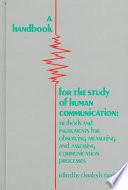
A Handbook for the Study of Human Communication

Methods and Instruments for Observing, Measuring, and Assessing Communication Processes

This book describes the available options, and the rationale for selecting among them, for observing, measureing or assessing process of communication. This approach contrasts radically to the one taken in many preceding volumes which explain the applicability of general types of quantitative research, for example, content analysis, laboratory experiments, and statistical analysis, to the study of communication. This approach focuses on the methodological problems and solutions unique to the study of communication. It provides the readers with an outline of the problems and/or alternatives that face the researcher.

This book describes the available options, and the rationale for selecting among them, for observing, measureing or assessing process of communication.

Neuromotor Mechanisms in Human Communication

This monograph is based on 20 years of research with patients who have experienced pathology in one hemisphere of the brain. It deals with brain mechanisms in human communicative behavior, and with related motor functions, from a broadly biological point of view. In so doing, the work discusses the possible evolutionary origins of human communication, the relation of brain mechanisms in communicative behavior to analogous nonhuman behaviors, and the neural systems involved in various levels and kinds of communication. In addition, noncommunicative mechanisms which parallel those used in communication--such as manual and oral praxis, and constructional behavior-- are outlined in detail. Individual differences in brain organization for such functions, related to hand preference and sex, are also explored. Although there is extensive reference to central nervous system pathology, the emphasis throughout is on how the findings contribute to understanding normal brain mechanisms. Much new data is presented along with the theoretical treatment of human communication which emphasizes a behavioral rather than a linguistic approach. This in turn provides continuity with nonhuman primates and early hominids. The work will interest psycholinguists, cognitive psychologists, neurologists, clinical neuropsychologists, speech pathologists, and advanced students in these fields.

The work will interest psycholinguists, cognitive psychologists, neurologists, clinical neuropsychologists, speech pathologists, and advanced students in these fields.